New Construction · November 2, 2026 · 7 min read
New Custom Home Costs: Rolling Hills vs Palos Verdes Estates
Compare the costs, timelines, and regional nuances of building a new custom home in Rolling Hills versus Palos Verdes Estates on the Peninsula.
- 5.0 on Google reviews (opens in a new tab)
- Licensed & bonded · CSLB #1130785
- Office in Rolling Hills Estates
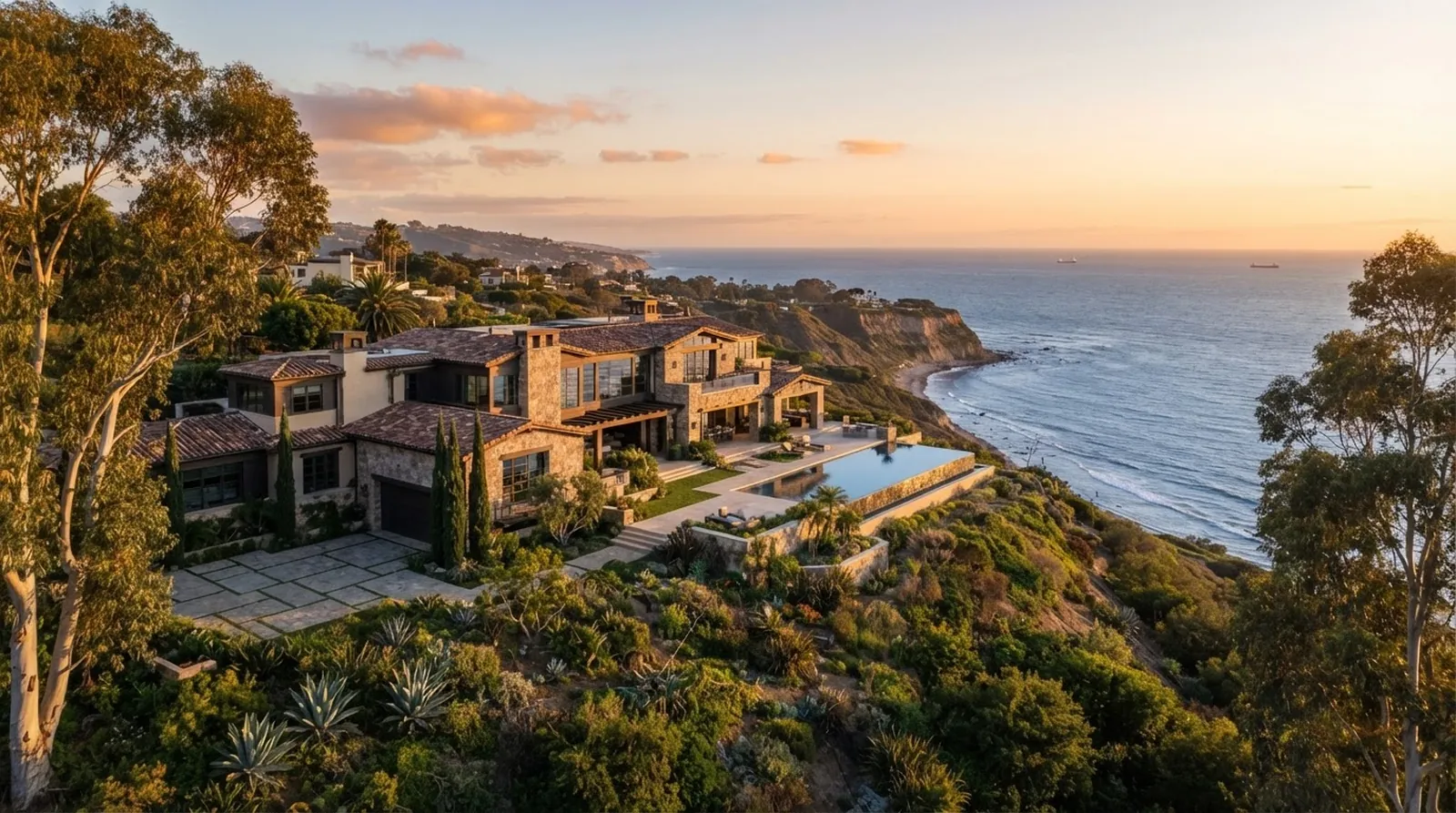
The Palos Verdes Peninsula offers a rare kind of coastal living. Morning fog rolls through the deep canyons, and afternoon light catches the mature eucalyptus trees along the trails. Whether you are looking out over the Pacific coastline or enjoying the quiet expanse of a hillside equestrian property, building a custom house here is about capturing that connection to the land.
Choosing between the distinct communities on the hill shapes both the design of your property and the journey to complete it. Rolling Hills provides vast equestrian properties with a rural, private feel behind its gates. Palos Verdes Estates hugs the bluffs, offering terraced lots with dramatic ocean views and a rich architectural heritage.
As a licensed California general contractor, Palos Verdes Builders builds, remodels and renovates on the Palos Verdes Peninsula. We know that understanding the financial commitment is the first step in bringing your vision to life. To help you plan effectively, our estimates are shown as ranges with their assumptions. This guide breaks down the financial and temporal realities of constructing a new house in these two distinct coastal enclaves.
The Character of the Land
A new house begins with the dirt it sits on, and the dirt here is unique. In Rolling Hills, properties are typically large, often spanning several acres of rolling terrain. The community values its rural character, characterized by white rail fences, miles of riding trails, and wide open spaces between neighbors. Building here means designing a structure that respects the natural topography and the strict ranch-style or traditional architectural guidelines set by the community association.
Palos Verdes Estates presents a completely different environment for construction. The lots are often smaller and steeper, clinging to the hillsides to maximize the sweeping views of the coastline and the ocean beyond. The architecture here leans heavily toward Mediterranean, Spanish, and early California styles, guided by an established art jury. The steep terrain often dictates the footprint and the flow of the house, requiring creative engineering to step the structure down the slope.
These fundamental differences in the land directly influence the design and construction process. A sprawling single-story ranch house on a gentle slope requires a very different approach to foundation work and site preparation than a multi-level villa built into a steep bluff. The cost of moving dirt, pouring concrete, and stabilizing the hillside varies wildly depending on which side of the Peninsula you choose. Understanding these local nuances is essential for anyone planning a major project in the area.
Comparing the Investment for a Custom Build
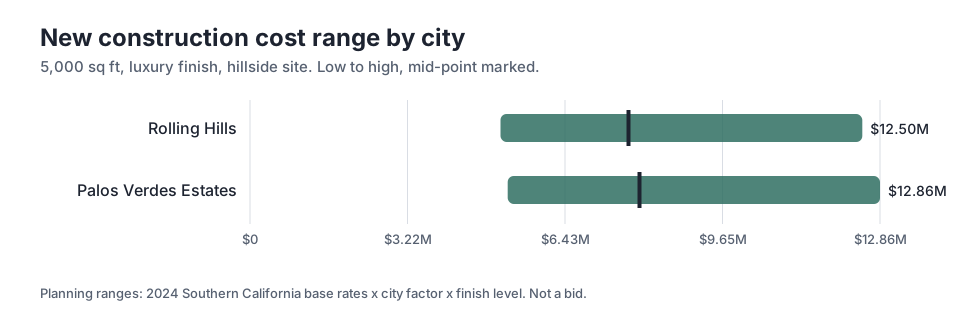
When planning a 5,000 sq ft new construction with a luxury finish, the financial commitment reflects the high standards of the region. The chart shows planning ranges, not a bid, giving you a realistic picture of the required investment before you begin drawing plans. In Rolling Hills, the mid-point for this type of project is $7.73M. The high end of the planning range can reach $12.50M, depending heavily on the complexity of the site, the length of the driveway, and the interior finishes chosen.
The numbers look slightly different just a few miles away on the bluffs. In Palos Verdes Estates, the mid-point for the same 5,000 sq ft luxury house sits at $7.95M. The high end of the planning range extends to $12.86M. These figures capture the hard costs of construction as well as the extensive site preparation, structural engineering, and architectural detailing required to meet the exacting standards of these coastal communities.
The slight premium in Palos Verdes Estates often stems from the physical constraints of the lots. Building on a steep hillside requires extensive shoring, deep concrete caissons, and significant retaining walls before the actual foundation can even be poured. In contrast, the larger, flatter pads often found in Rolling Hills might require less structural engineering for the foundation itself, though the sheer scale of the site brings its own costs in landscaping and site work.
What Drives the Cost Differences?
Site preparation is a major variable in coastal and canyon construction. Moving dirt is expensive, and exporting soil off the Peninsula adds significant transportation costs to the budget. A terraced lot in Palos Verdes Estates might require exporting large volumes of soil to carve out a driveway and a level building pad. The logistics of operating heavy machinery on narrow, winding streets also add to the labor hours and require careful coordination with the city and neighbors.
In Rolling Hills, the site challenges often revolve around infrastructure and scale rather than steep slopes. While you might not need as many retaining walls, the distance from the street to the house can be substantial. Long, winding driveways require extensive grading, base preparation, and paving. Additionally, bringing utilities like water, power, and sewer lines deep into a large, rural parcel involves significant trenching and material costs that are less common on the denser, more developed streets of Palos Verdes Estates.
Material selections and architectural mandates also play a major role in the final budget. Both communities have strict design review boards that dictate exterior materials. Authentic clay tile roofs, custom wood windows, and smooth trowel stucco finishes are standard expectations. The requirement to use premium, historically accurate materials ensures the neighborhood retains its character, but it also establishes a high baseline for the exterior finishes of any new construction.
Timelines from Design to Move-In
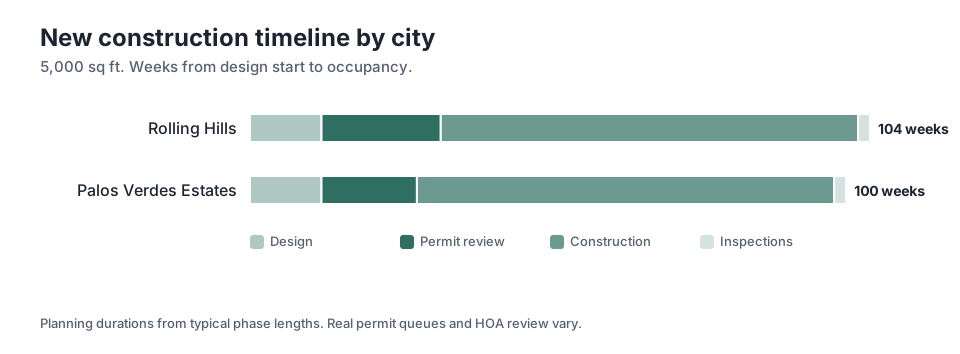
Building a custom house is a long-term endeavor that requires patience and careful planning. The estimated weeks from design start to occupancy for a 5,000 sq ft new construction reveal a multi-year commitment. The chart illustrates these planning ranges. In Rolling Hills, the TOTAL from design start to occupancy is 104 weeks. This timeline accounts for every phase, from the initial architectural sketches and engineering reports to the day you finally receive the keys and move in.
The timeline in Palos Verdes Estates is slightly shorter, though still substantial. Here, the TOTAL from design start to occupancy is 100 weeks. In both communities, the actual building phase takes up the majority of the schedule. The construction period alone is estimated at 70 weeks, reflecting the complex engineering, custom fabrication, and detailed finish work required for a luxury property. Weather delays, material lead times, and specialized labor availability all factor into this lengthy construction phase.
The design phase is estimated at 12 weeks for both areas, giving you and your architect time to develop floor plans, select finishes, and finalize the structural details. After construction concludes, final inspections typically take 2 weeks. The remaining weeks in the timeline are consumed by the municipal review and approval process, which varies depending on the specific city, the complexity of the design, and the current workload of the local building departments.
Navigating City Plan Review
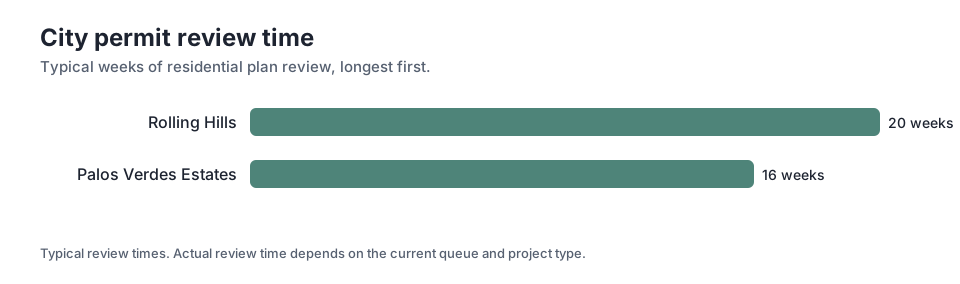
The approval process on the Peninsula is thorough and deliberate. Both communities prioritize preserving their visual character and protecting the natural landscape, which means every new design undergoes intense scrutiny. The chart highlights the typical weeks of city plan review used in the timeline ranges. In Rolling Hills, you should anticipate 20 weeks of city plan review before you can secure your permits and break ground on the project.
The review process involves multiple layers of approval. In Rolling Hills, the community association plays a major role, ensuring that the proposed house aligns with the ranch-style aesthetic and does not obstruct neighbors' views or disrupt the equestrian trails. The city building department then reviews the plans for structural integrity, grading, and drainage. This dual-layered review requires detailed documentation, neighborhood notifications, and often involves several rounds of revisions to satisfy all parties involved.
The timeline is slightly different in the neighboring community. In Palos Verdes Estates, the planning ranges include 16 weeks of city plan review. Here, the Homes Association and its art jury hold significant influence over the architectural style, exterior colors, roof pitches, and landscaping. While the review period is slightly shorter than in Rolling Hills, the standards for historical accuracy and neighborhood compatibility are just as strict.
Preparing for the Journey
Embarking on a custom build requires assembling a team of professionals who understand the specific demands of the Peninsula. An architect with local experience will know how to navigate the art jury or the community association, saving you valuable time during the review process. A civil engineer familiar with the local soil conditions is essential for designing a foundation that will stand the test of time against the coastal elements and the hillside terrain.
As a licensed California general contractor, Palos Verdes Builders builds, remodels and renovates on the Palos Verdes Peninsula. We recommend engaging your builder early in the design phase. A builder can provide practical feedback on the constructability of the design and offer insights into how material choices will impact the budget. This collaborative approach helps align the architectural vision with the financial reality.
The final step before breaking ground is securing your financing and finalizing your living arrangements for the duration of the project. With construction taking well over a year, you need a comfortable place to live while the work progresses. By understanding the costs, the timelines, and the local nuances, you can approach your new custom house with confidence and clear expectations.
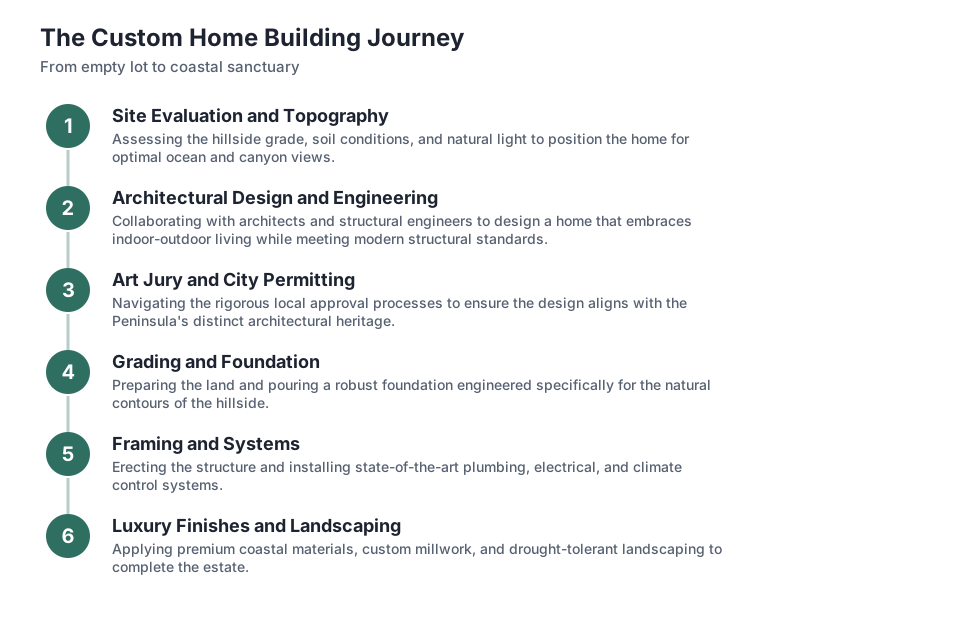
Key takeaways
- Building a 5,000 sq ft luxury house involves a significant financial commitment, with planning ranges reaching up to $12.50M in Rolling Hills and $12.86M in Palos Verdes Estates.
- The total timeline from design to occupancy spans an extended period, requiring 104 weeks in Rolling Hills and 100 weeks in Palos Verdes Estates.
- Steep hillside lots in Palos Verdes Estates often demand extensive structural engineering and retaining walls, driving up initial site preparation costs.
- Rolling Hills properties present unique challenges related to their large scale, including long driveways and extensive utility trenching.
- Navigating the local approval process requires patience, with 16 to 20 weeks dedicated solely to city plan review and community association approvals.
Questions
Frequently asked questions
Why does site preparation cost so much on the Peninsula?
Coastal and canyon terrain often requires extensive grading, soil export, and structural engineering. Steep lots need retaining walls and deep caissons, while large rural lots require long driveways and utility trenching, all of which add significant labor and material costs before the foundation is poured.
How long does the actual construction phase take for a custom house?
For a 5,000 sq ft luxury house, the construction phase alone is estimated at 70 weeks. This accounts for complex engineering, custom fabrication, detailed finish work, and the logistical challenges of building in hillside communities.
What role does the art jury or community association play?
These organizations enforce strict design guidelines to preserve the neighborhood's architectural character. They review exterior materials, colors, roof pitches, and landscaping. Their approval is required before the city will issue building permits, making them a critical part of the planning process.
Can we speed up the city plan review process?
The review timelines—typically 16 weeks in Palos Verdes Estates and 20 weeks in Rolling Hills—are largely fixed due to the thorough nature of the inspections and community notifications. Hiring an architect familiar with local guidelines can prevent delays caused by rejected designs, but the baseline review period remains substantial.
Are the estimates provided a final bid for construction?
No, the figures provided are planning ranges, not a bid. They are designed to give you a realistic picture of the required investment based on historical data and current market conditions. A final bid requires completed architectural and engineering plans.