Kitchen Remodeling · November 7, 2026 · 8 min read
How Much Does a Rolling Hills Kitchen Remodel Cost?
Planning a major kitchen remodel in Rolling Hills requires understanding local costs, finish levels, and how to connect your space to the outdoors.
- 5.0 on Google reviews (opens in a new tab)
- Licensed & bonded · CSLB #1130785
- Office in Rolling Hills Estates
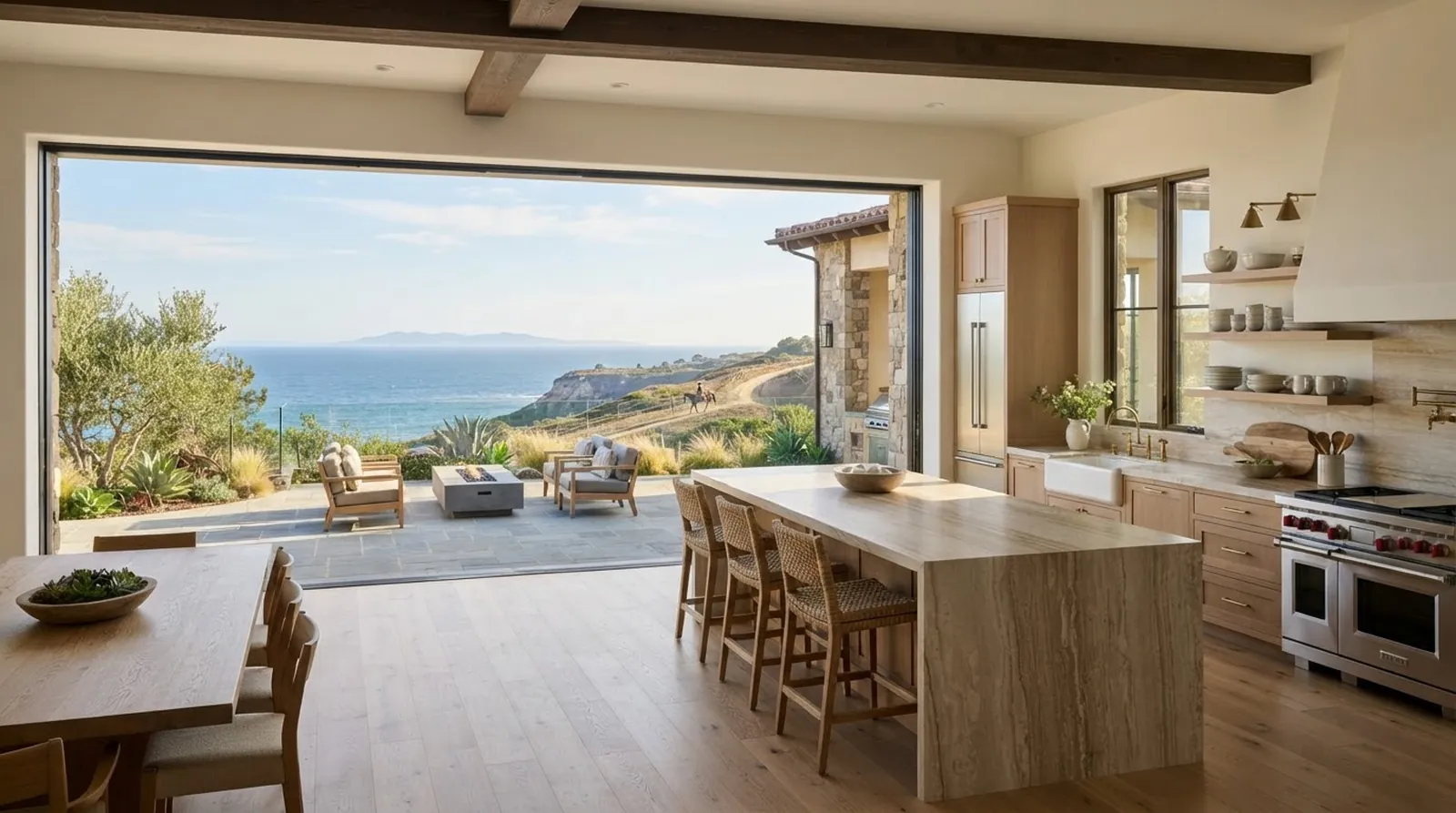
Rolling Hills offers a distinct way of living, defined by open canyons, equestrian trails, and coastal light. Homes in this community are designed to breathe, naturally drawing the outside environment into the interior spaces. When homeowners decide to update their properties, the kitchen almost always becomes the focal point for this connection. A well-planned kitchen does far more than serve as a utilitarian place to prepare meals. It anchors the entire home, linking interior living spaces with sunlit patios, shaded gardens, and the natural beauty of the Palos Verdes Peninsula.
Understanding the financial commitment for such a project is the critical first step in planning. As a licensed California general contractor that builds, remodels and renovates on the Palos Verdes Peninsula, we know that establishing clear expectations early prevents surprises later. We provide estimates shown as ranges with their assumptions, helping homeowners make informed choices during the conceptual design phase. Setting a realistic budget allows you to focus on the creative aspects of the remodel rather than worrying about unexpected financial hurdles.
A major kitchen renovation involves complex structural changes, upgraded electrical systems, and the installation of premium materials. Whether you are opening up load-bearing walls to capture canyon views or installing custom cabinetry, the specific choices you make will dictate the final investment. This guide explores the realistic costs of remodeling a kitchen in Rolling Hills, focusing heavily on premium materials, thoughtful architectural design, and the logistical realities of building in a private community.
The Cost of a Premium Kitchen in Rolling Hills
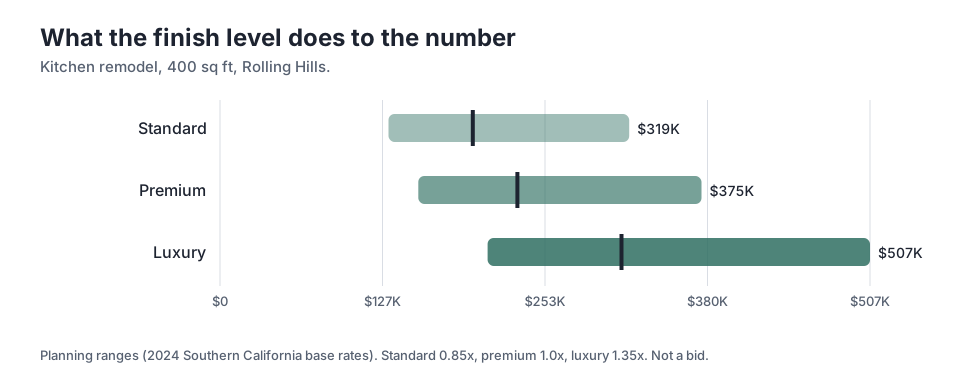
When planning a 400 sq ft kitchen remodel, the level of finish you select plays a massive role in determining the final number. The accompanying chart illustrates exactly how different material choices shift the overall budget. For a premium finish in Rolling Hills, the planning mid-point lands at $232K. This baseline assumes the use of semi-custom cabinetry, professional-grade appliance packages, and natural stone countertops. It represents a standard of quality that aligns well with the architectural expectations of homes on the Peninsula.
Moving from a premium finish to a luxury finish increases the necessary investment significantly. A luxury finish for the exact same 400 sq ft space reaches a planning mid-point of $313K. The financial difference often comes down to fully custom millwork, integrated appliance panels that hide refrigerators and dishwashers, rare stone slabs, and advanced lighting systems. These bespoke elements require specialized local labor, precise installation techniques, and substantially longer lead times to procure and fabricate.
Conversely, choosing standard finishes can keep the project closer to the $197K mid-point. However, homeowners in Rolling Hills typically opt for premium or luxury materials to match the structural integrity and market value of their properties. Standard finishes often rely on mass-produced materials that may not offer the longevity or aesthetic appeal desired in a custom home. Understanding these distinct tiers helps you align your design aspirations with a realistic financial framework long before you pay an architect to draw up the first set of construction plans.
How Material Choices Drive the Budget
The financial gap between a standard remodel and a luxury overhaul is substantial and entirely driven by client selections. As the data shows, a luxury finish applies a 1.35x multiplier to the baseline costs, while a standard finish uses a 0.85x multiplier. This variance is largely determined by what goes into the room after the drywall is finished and the rough plumbing is hidden. The structural framing and basic electrical wiring cost roughly the same regardless of the finish level, but the visible surfaces change everything.
Cabinetry is almost always the largest single line item in a kitchen budget. A premium kitchen might utilize factory-built cabinets with customized interior inserts for organization. In contrast, a luxury kitchen often features cabinets built entirely from scratch by local woodworkers. These custom boxes are perfectly scribed to uneven walls, finished with custom stains, and built to exact specifications. The labor required to install custom cabinetry is also much higher than simply placing and securing factory-made boxes.
Countertops and appliances follow closely behind cabinetry in cost impact. Natural quartzite or porcelain slabs cost significantly more to purchase, transport, and fabricate than standard quartz options. Professional appliance packages from top-tier brands can easily double the appliance budget compared to standard premium lines. Features like built-in espresso machines, dual dishwashers, and full-height wine columns push the budget upward. Every hardware choice, plumbing fixture, and light pendant adds up, moving the project along that spectrum from premium toward luxury.
Comparing Costs Across the Peninsula
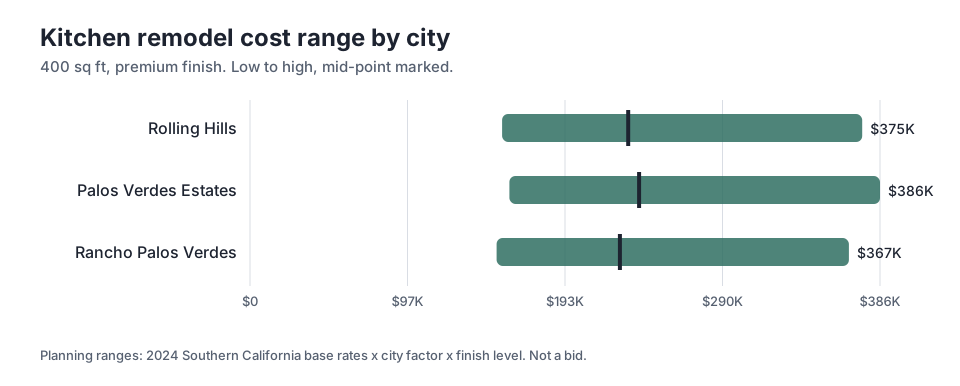
While material costs remain fairly constant across Southern California, location-specific factors can influence the overall budget for a major renovation. The second chart compares the planning ranges for a premium 400 sq ft kitchen across three distinct local areas. In Rolling Hills, the premium mid-point sits at $232K. This figure accounts for the specific conditions and requirements of building within the city limits.
Just down the hill in Rancho Palos Verdes, the mid-point for the exact same premium finish dips slightly to $227K. Meanwhile, a comparable project in Palos Verdes Estates sees a planning mid-point of $239K. These variations are not arbitrary or random. They reflect the daily realities of working in different municipalities, each with its own permitting processes, site access challenges, and architectural review boards that dictate how a project must be executed.
Rolling Hills presents unique logistical considerations that factor into the cost. The expansive lots and private roads offer plenty of space for staging materials, but strict community rules govern work hours and contractor access. Palos Verdes Estates often involves navigating tighter hillside streets, managing limited parking for tradespeople, and securing strict art jury approvals for exterior changes. These local nuances affect labor hours, delivery fees, and project timelines, which in turn shape the final cost of the remodel.
Understanding these municipal differences is crucial for accurate planning. A project that might take four months in one city could easily stretch to five or six in another due to inspection schedules and restricted working hours. Homeowners must account for these hidden timeline extensions, as longer projects naturally incur higher costs for site supervision, temporary facilities, and ongoing project management.
Connecting the Kitchen to the Outdoors
A defining feature of a classic Rolling Hills home is its intimate relationship with the surrounding landscape. Remodeling a kitchen here almost always involves improving access to adjacent patios, gardens, and equestrian trails. Achieving this connection requires far more than just installing a new glass door. It often demands significant structural work to open up exterior walls and reframe the back of the house to maximize natural light and ventilation.
Installing large pocketing or folding glass door systems means inserting heavy steel beams to carry the weight of the roof above. The structural engineering must account for strict California seismic requirements, which adds considerably to the initial framing budget. Additionally, matching the interior kitchen floor level with the exterior patio creates a smooth transition, but it requires careful waterproofing, custom flashing, and precise concrete work to prevent water intrusion during winter rains.
The architectural result is a kitchen that feels twice its actual size. When the large glass doors are pushed back into the walls, the kitchen island often becomes an outdoor serving counter, and the coastal breeze naturally cools the house. While the heavy structural work increases the initial investment, the lifestyle benefits and the way the home interacts with the canyon light make it a top priority for most homeowners planning a major renovation.
The Design and Construction Sequence
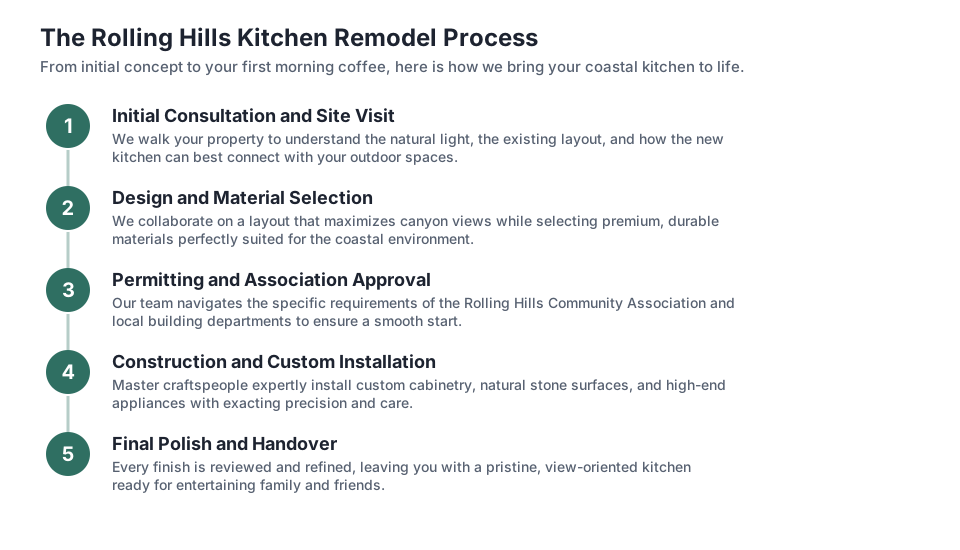
A successful kitchen remodel follows a logical, step-by-step progression, starting long before any demolition begins. The first phase is entirely conceptual and design-focused. Homeowners work closely with architects and interior designers to establish the layout, select all visible finishes, and clearly define the scope of work. This early stage is the proper time to decide if you are moving underground plumbing lines, vaulting a ceiling, or adding new square footage to the home footprint.
Once the design is locked in and plans are drawn, the engineering and permitting phase begins. Submitting structural plans to the local building department and community associations takes patience and time. As a licensed California general contractor, we emphasize the importance of ordering materials during this administrative window. Custom cabinets, specialty stone slabs, and professional appliances often have lead times stretching to several months. Waiting until construction starts to order them will inevitably stall the project.
Construction itself is the final, most visible step in the sequence. It begins with demolition and structural framing, moves through rough plumbing and electrical installations, and finishes with drywall, flooring, and cabinetry installation. Because we build, remodel and renovate on the Palos Verdes Peninsula, we structure our schedules around the specific requirements of local cities. This local focus ensures inspections happen promptly and work progresses steadily from one trade to the next without unnecessary delays.
The final weeks of construction are dedicated to the finishing touches. This includes templating and installing countertops, hooking up plumbing fixtures, and completing the final paint work. A thorough walkthrough identifies any minor adjustments needed before the space is turned over to the homeowner. Following this sequence respects the complexity of a major remodel and protects the financial investment being made in the property.
Managing Site Logistics in a Private Community
Building and remodeling in Rolling Hills requires careful, daily attention to site management and logistics. The community is entirely private, with guarded gate access and specific regulations designed to maintain the quiet, rural atmosphere residents expect. Contractors must coordinate daily gate clearances for large work crews, delivery trucks, and city inspectors. Missing a single clearance can delay a critical concrete pour or force a major material drop to be rescheduled for the following week.
Protecting the existing property is another major consideration during a large-scale renovation. Many homes feature mature landscaping, custom driveways, and close proximity to active horse trails. Heavy equipment, lumber drops, and large roll-off dumpsters must be placed carefully to avoid damaging tree roots or cracking paver driveways. Dust control is absolutely essential, especially when cutting natural stone or sanding drywall, to keep the disruption to the rest of the house and the neighbors to an absolute minimum.
Proper planning turns these potential logistical hurdles into routine, manageable tasks. By setting clear expectations with all subcontractors and scheduling material deliveries well in advance, the construction site remains organized and efficient. A clean, well-managed site is inherently safer, allows tradespeople to work more effectively, and ultimately leads to a much higher quality finished product. It also minimizes the stress on homeowners who are living adjacent to a major construction zone for several months.
Key takeaways
- A premium 400 sq ft kitchen remodel in Rolling Hills has a planning mid-point of $232K, while luxury finishes push that mid-point to $313K.
- Custom cabinetry, professional appliances, and rare stone slabs are the primary drivers of the cost difference between finish levels.
- Opening the kitchen to outdoor living spaces requires structural engineering and heavy steel beams, impacting the initial framing budget.
- Permitting, site access, and local community rules create slight cost variations between Rolling Hills, Palos Verdes Estates, and Rancho Palos Verdes.
Questions
Frequently asked questions
Why is custom cabinetry so much more expensive than factory-built options?
Custom cabinetry is built specifically for your kitchen's dimensions, allowing for exact scribing to walls and customized interior storage. The higher cost reflects the specialized local labor, premium wood species, and multi-step finishing processes required compared to mass-produced factory boxes.
Do I need an architect for a kitchen remodel?
If your remodel involves moving load-bearing walls, changing exterior doors and windows, or adding square footage, you will need structural plans. An architect or structural engineer is necessary to draft these plans and secure the required building permits from the city.
How long does a major kitchen renovation take?
The construction phase for a major kitchen remodel typically takes three to five months, depending on the complexity of structural changes. However, the design, permitting, and material ordering phases can add several months to the overall timeline before demolition even begins.
Can we live in the house during a kitchen remodel?
Yes, many homeowners stay in their homes, but it requires setting up a temporary kitchen in another room. Expect significant dust, noise, and daily disruptions. If the remodel involves extensive structural work or whole-house flooring changes, moving out temporarily may be more practical.
How do we choose between a premium and a luxury finish?
The choice depends on your architectural goals and how you use the space. Premium finishes offer excellent durability and beautiful aesthetics using high-quality manufactured products. Luxury finishes are ideal if you want completely unique, handcrafted elements, integrated appliances, and rare materials that cannot be replicated.
Keep reading
Related guides
More from the same places and topics.
How Long Does It Take to Build a Custom Home in Rolling Hills?
Discover the detailed timeline for building a custom home on the Palos Verdes Peninsula, from the initial design phase to final city inspections.
New Custom Home Costs: Rolling Hills vs Palos Verdes Estates
Compare the costs, timelines, and regional nuances of building a new custom home in Rolling Hills versus Palos Verdes Estates on the Peninsula.
Cost to Build an ADU in Rolling Hills vs Palos Verdes Estates
Compare the costs, timelines, and planning phases for building a detached accessory dwelling unit in Rolling Hills and Palos Verdes Estates.